Glendullan Distillery, Dufftown: The Quiet Workhorse of Speyside
Glendullan at a glance
| Region | Speyside (Dufftown, Moray) |
| Founded | 1897 — first spirit 1898 |
| Owner | Diageo |
| Visitor centre | No — not open to the public |
| Tours | None; a working production site (occasional access during the Spirit of Speyside festival) |
| Bottled as | The Singleton of Glendullan; backbone of blends |
Overview
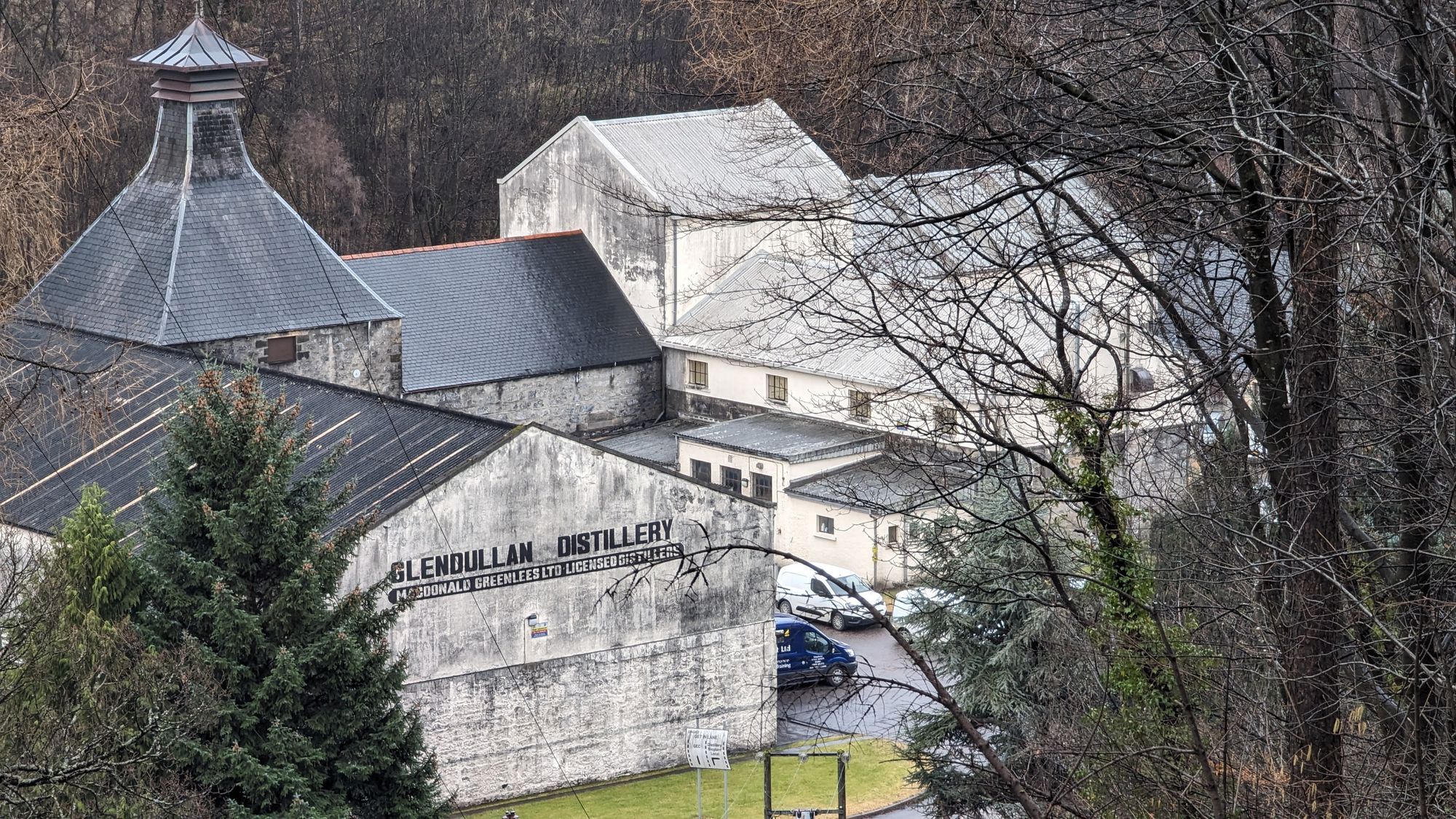
Glendullan is one of the seven distilleries that made Dufftown the whisky capital of Speyside — but unlike its famous neighbour Glenfiddich, you can’t walk in and tour it. It is a working production distillery owned by Diageo, with no visitor centre, quietly making a soft, sweet Speyside malt that most people have drunk without ever knowing the name — because for most of its life Glendullan has gone into blends. You can, however, see it plainly from the town: the big grey buildings above the River Fiddich still carry the old painted sign, “Glendullan Distillery — MacDonald Greenlees Ltd, Licensed Distillers.”
The full history
Glendullan was the last of Dufftown’s original seven distilleries to be built. It was founded in 1897 by William Williams & Sons, an Aberdeen firm of blenders and whisky brokers, and the first spirit ran in 1898 — right at the peak of the great Victorian whisky boom, when Dufftown seemed to be adding a distillery a year. It was well sited: the River Fiddich powered a water wheel, and the Great North of Scotland Railway ran a siding almost to the door.
The distillery’s fortunes became tied to the blenders. In the 1920s it passed to Macdonald Greenlees — the firm behind the once-famous Old Parr blend — whose name still marks the wall, and then into the great Distillers Company (DCL), the ancestor of today’s Diageo. In 1972 a second, larger, modern Glendullan was built right alongside the Victorian one, and for a decade the two distilleries ran side by side. The original 1897 distillery closed in 1985, its handsome old buildings kept on for engineering and coppersmithing work; the 1972 stillhouse carries the name forward today.
For most of its life Glendullan’s whisky disappeared quietly into blends, and it was long a favourite dram of the workers at Dufftown. In recent years Diageo has given it a single-malt identity of its own, bottling it as The Singleton of Glendullan — a soft, fruity, approachable Speyside sold especially into the American market. It remains one of the region’s genuine workhorse malts: little celebrated, rarely seen, but quietly essential.
The water & the land
Like every Speyside distillery, Glendullan is really a product of its water. Its process water is drawn from the Goats Well spring in the Conval Hills above the town, with the River Fiddich running right alongside the distillery — the same river that once turned its water wheel. Soft, clean hill water like this is a large part of why so many distilleries crowded into this one small corner of Moray.
Glendullan has no clan of its own — it was a hard-headed commercial venture, built by an Aberdeen blending firm to feed the blends. But the ground it stands on has a lineage. Dufftown itself was laid out in 1817 by James Duff, 4th Earl of Fife, to give work to soldiers home from the Napoleonic Wars — so the whole whisky town is a creation of the Duff family, the Earls of Fife. And the wider Speyside these distilleries share was historically Grant and Gordon country — the lands of Clan Grant of Strathspey and the Gordon earls, the families whose barley, water and labour underpinned the whisky trade long before the blenders arrived.
Seeing it
Glendullan is not open to visitors — there is no tour or visitor centre, and it is a live production site. The one time the doors sometimes open is during the annual Spirit of Speyside Whisky Festival (usually late April/May), when a handful of the closed distilleries run special events; check the festival programme if that appeals. Otherwise, the best you’ll do is admire the buildings and the old painted sign from the edge of Dufftown — which, with six other distilleries within walking distance, is hardly a hardship.
Nearby & more whisky
- Its famous neighbour, free to walk into: Glenfiddich, Dufftown.
- The whisky town itself: Dufftown — seven distilleries and a clock tower.
- The whole picture: Scotch whisky — regions, distilleries & the oldest of all.
Sources
- Glendullan distillery — Wikipedia · Whisky.com distillery database.
- Diageo / The Singleton of Glendullan; Spirit of Speyside Whisky Festival.