Fraserburgh: “The Broch” — Scotland’s Great Shellfish Port & the First Mainland Lighthouse
Overview — a proper working town
Fraserburgh — “the Broch” to everyone in the north-east — sits right on the corner of Aberdeenshire where the coast turns from north-facing to east-facing. It’s no polished tourist town; it’s a proper working fishing port, in fact Scotland’s largest shellfish landing port, and that gritty, salt-and-diesel character is exactly what makes it worth a stop. It also holds a genuine piece of history: the first lighthouse ever built on the Scottish mainland.
Where it is
Fraserburgh stands at the north-east tip of Aberdeenshire, about 40 miles north of Aberdeen and a short hop east of the fishing town of Banff. It’s the natural anchor for this whole stretch of coast — Aberdour Bay, Rosehearty and Pennan all lie just to the west.
The harbour
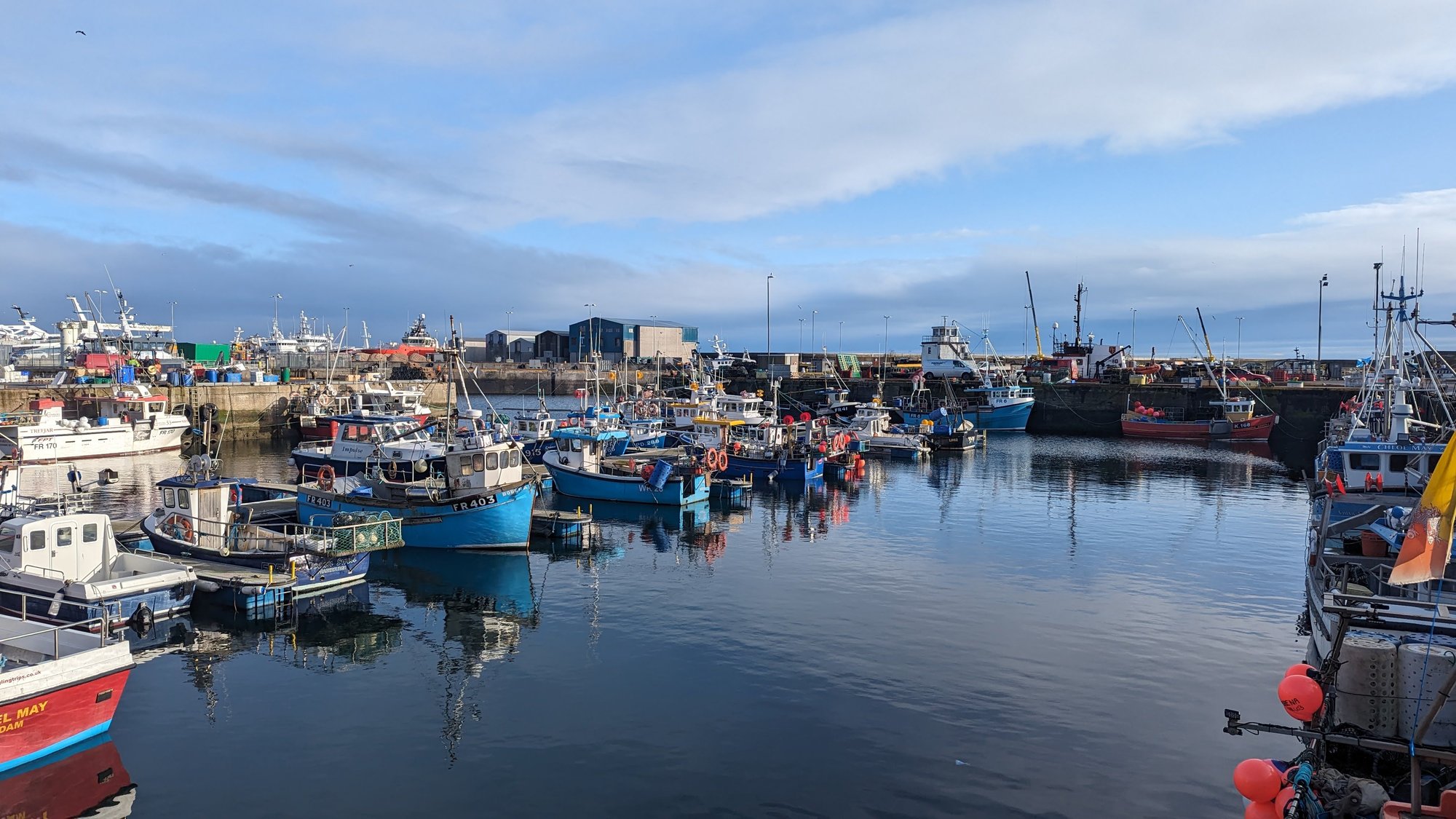
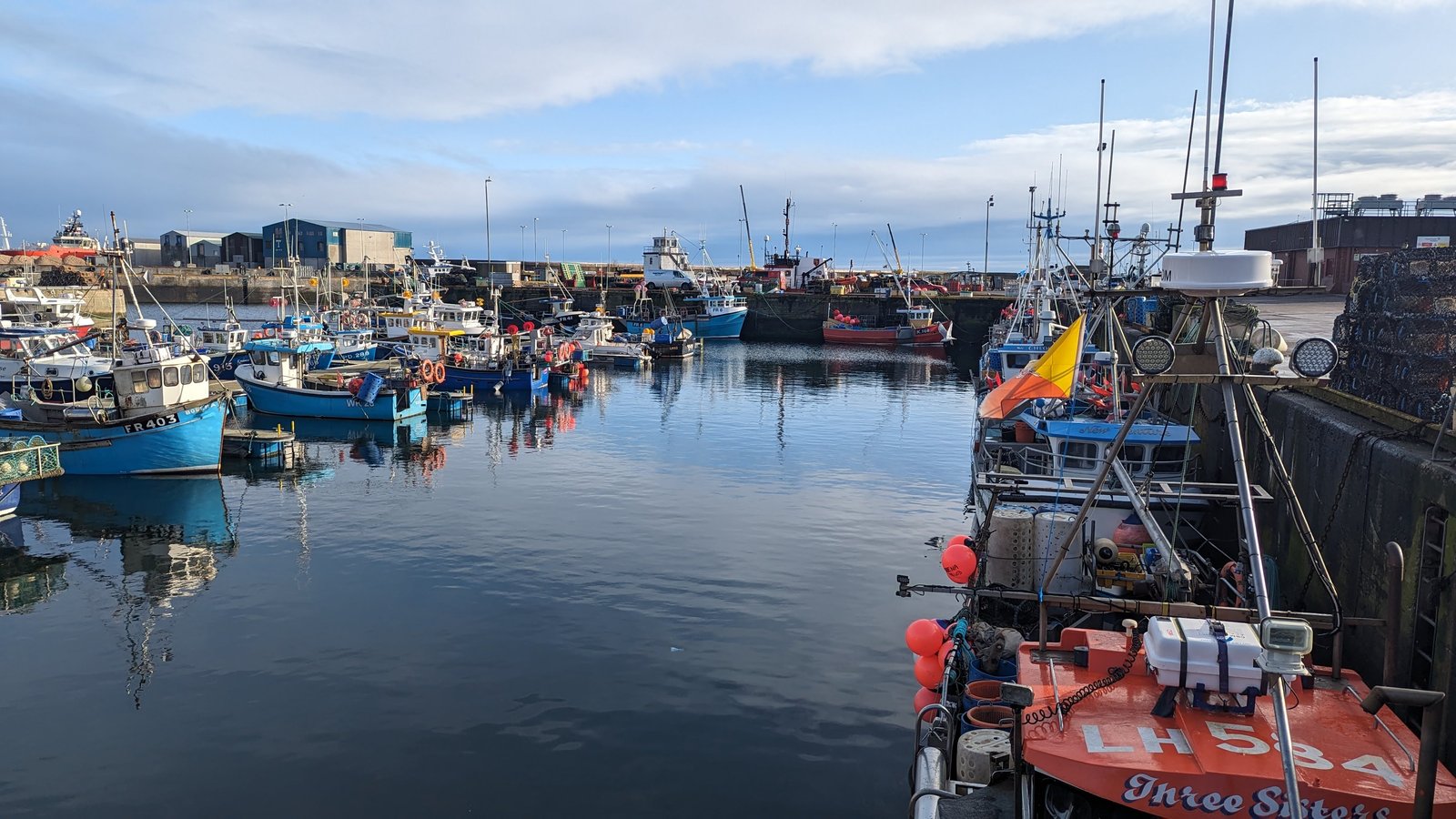
The harbour is the town, really. Fraserburgh has landed fish since the 1500s, and today its quays and market handle huge tonnages of langoustine, crab, lobster and white fish. We had a wander round on a crisp, still morning, the water like glass and the blue and red boats mirrored in it — a grand, honest working scene. If you like a real harbour rather than a prettified one, you’ll love it.
Kinnaird Head & the Museum of Scottish Lighthouses
Fraserburgh’s headline sight is Kinnaird Head, on the western side of the harbour. Here, in 1787, the very first lighthouse on mainland Scotland was lit — and remarkably, it was built straight into an existing castle. Kinnaird Head Castle, a Fraser tower house of around 1570, had its top floors converted by engineer Thomas Smith to carry the light; in 1824 the great Robert Stevenson (of the famous lighthouse-building Stevensons) re-engineered it with a new tower. Today the castle and light house the excellent Museum of Scottish Lighthouses, where you can climb the original tower and see the great lenses gathered from lights all round the coast. As it’s a castle too, we’ve noted it in our Castles of Scotland collection.
The Wine Tower & the oldest stone in town
Right beside the lighthouse, on the very edge of the cliff, stands the strange little Wine Tower — the oldest building in Fraserburgh, dating to the 16th century. It’s a squat three-storey vault with beautifully carved stone pendants inside, and a good story: it may have served as a secret Catholic chapel for the wife of the Protestant laird Sir Alexander Fraser. (It’s currently closed for conservation, but worth seeing from outside.)
The Frasers & the founding of the Broch
The town owes its very name to the Frasers. It was Sir Alexander Fraser of Philorth who developed the harbour and won a burgh charter in 1546, and even briefly founded a university here in the 1590s — a short-lived venture, but a bold one. The Frasers are one of Scotland’s great families, and this coast is Fraser country through and through. See our Clan Fraser of Lovat page for the family’s full story — from here in the north-east to Lovat, the Battle of the Shirts and Culloden.
The herring boom & the “silver darlings”
What made Fraserburgh great was the herring — the “silver darlings.” Through the 19th and early 20th centuries the Broch was one of the busiest herring ports in Europe, its basin packed gunwale to gunwale with sailing drifters. Following the boats came the famous herring girls, gutting and packing the catch at astonishing speed and travelling the whole coast with the season — from Stornoway and Lerwick right down to Great Yarmouth. Two world wars and the collapse of the herring stocks ended the boom, but the town reinvented itself around white fish and shellfish, and it lands them still.
Tragedy at sea — the Fraserburgh lifeboat disasters
No honest account of Fraserburgh can leave out its darkest thread. This is a town that has given its own to the sea again and again, and its lifeboat station has suffered three terrible disasters — a toll matched by almost nowhere else in Britain. In all, thirteen lifeboatmen were lost:
- 1919 — on 28 April the lifeboat Lady Rothes capsized crossing Fraserburgh Bay on her way to a naval drifter in distress. Coxswain Andrew Noble and second coxswain Andrew Farquhar were drowned.
- 1953 — on 9 February the John and Charles Kennedy capsized at the very mouth of the harbour after escorting fishing boats to safety. Six of her seven crew were lost; only one man survived.
- 1970 — on 21 January the Duchess of Kent was overturned by a freak wave while standing by a Danish trawler in a full gale. Five of her six crew died.
A memorial in the town remembers them. If you stop at the harbour, it’s worth a quiet moment for the men who launched into weather no one else would face.
“Little London” — Fraserburgh in the war
Fraserburgh paid a heavy price in the Second World War, too. As the first stretch of British mainland the Luftwaffe crossed on the run from their Norwegian bases, and home to a strategic tool works with convoys passing offshore, the town was hit hard: 17 air raids between 1940 and 1943 killed 53 people and injured more than 300. The worst came on Bonfire Night, 5 November 1940, when a single raid killed 31. At one point, per head of population, more people were being killed here than in London — which earned the Broch the grim nickname “Little London.”
Fraserburgh Beach
South of the harbour runs Fraserburgh Beach — a long, wide sweep of sand backed by dunes, part of the great Fraserburgh–St Combs strand. It’s a noted surfing beach (the north-east gets a proper swell) and a fine walk in any weather.
Nearby — the Buchan coast
- Aberdour Bay & New Aberdour — a secluded red-cliff beach just west, where we headed next.
- Rosehearty & Pennan — the old fishing villages along the north coast; Pennan starred in the film Local Hero.
- Cruden Bay & Dunnottar Castle — further down the Aberdeenshire coast toward Stonehaven.
- See the wider picture in our Castles of Scotland collection.
Sources
- First-hand: Kevin & family, Fraserburgh harbour, 27 February 2024 (own photos).
- Museum of Scottish Lighthouses, Historic Environment Scotland & Wikipedia (1787 first mainland light, Thomas Smith, Robert Stevenson, the Wine Tower, the Frasers).
- On the town’s history: RNLI and the Sunday Post (the 1919/1953/1970 lifeboat disasters); the Press & Journal (“Little London” and the wartime raids); the Scottish Fisheries Museum (the herring boom).